Finding the bottleneck a manufacturer couldn't seeEncontrar el cuello de botella que un manufacturero no podía ver
A manufacturer was missing a third of its shipments and blaming capacity. The data said something else. I modeled their real production data, found the actual constraint, and built the decision system and agents that run on the spreadsheets the team already uses.Un manufacturero perdía un tercio de sus embarques y le echaba la culpa a la capacidad. El dato decía otra cosa. Modelé sus datos reales de producción, encontré la restricción real y construí el sistema de decisión y los agentes que corren sobre los mismos spreadsheets que el equipo ya usa.
The problemEl problema
A ~50-person auto-parts manufacturer was hitting about 69% of its shipments on time and covering the gap with Saturdays and overtime. Inside the company, the read was simple: not enough capacity. That story had a fix attached to it — more machines, more shifts, more hours — and it was expensive. Nobody had checked whether it was true. So the question I started with wasn't "how do we add capacity," it was "is capacity actually the constraint?"Un manufacturero de autopartes de ~50 personas cumplía cerca del 69% de sus embarques a tiempo y cubría el hueco con sábados y horas extra. Adentro de la empresa, la lectura era sencilla: falta capacidad. Esa historia venía con una solución pegada — más máquinas, más turnos, más horas — y era cara. Nadie había verificado si era cierta. Así que la pregunta con la que arranqué no fue "cómo agregamos capacidad", fue "¿la capacidad es de verdad la restricción?"
How I worked itCómo lo trabajé
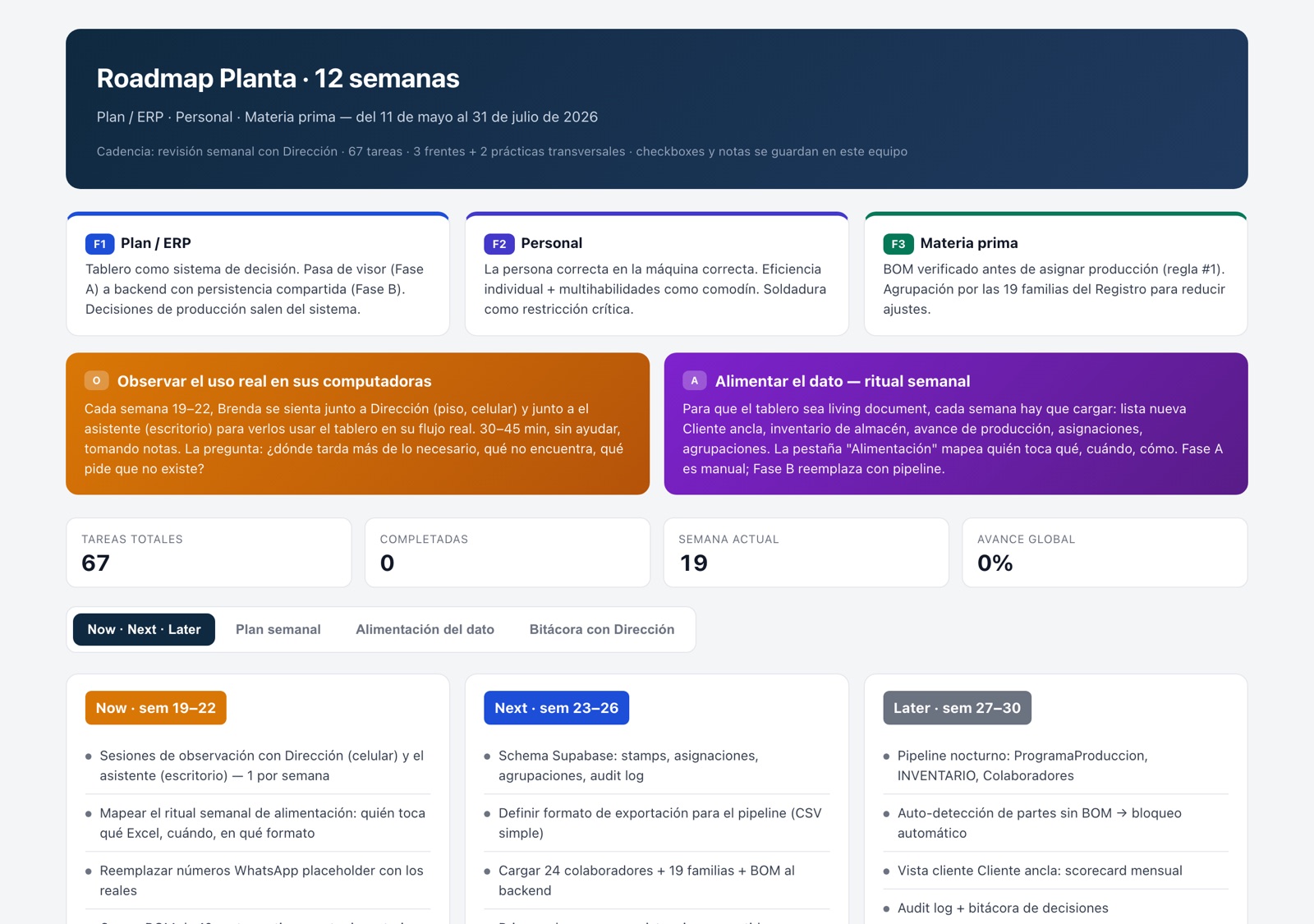
I started with their data. Six live spreadsheets, about 15,000 process rows, 697 parts — the record of how the operation actually ran, not how anyone described it. I modeled it end to end: how work moved, where it waited, which parts depended on which people. Then I closed the laptop and went to the floor.Empecé con su dato. Seis spreadsheets vivos, unas 15,000 filas de proceso, 697 partes — el registro de cómo corría de verdad la operación, no de cómo la describían. Lo modelé de punta a punta: cómo se movía el trabajo, dónde esperaba, qué partes dependían de qué personas. Luego cerré la laptop y me fui al piso.
I sat with the people who run it and watched them work, taking notes. Numbers tell you where to look; the floor tells you why. Every claim got marked as one of two things: something the data proved, or something we still had to confirm. That discipline kept the confident guesses out — including my own — and it's what let the findings hold up when they contradicted what everyone already believed.Me senté con las personas que operan y las observé trabajar, tomando notas. Los números te dicen dónde mirar; el piso te dice por qué. Cada afirmación quedó marcada como una de dos cosas: algo que el dato probaba, o algo que todavía teníamos que confirmar. Esa disciplina dejó fuera las suposiciones seguras — incluidas las mías — y es lo que permitió que los hallazgos aguantaran cuando contradijeron lo que todos ya creían.
What I foundQué encontré
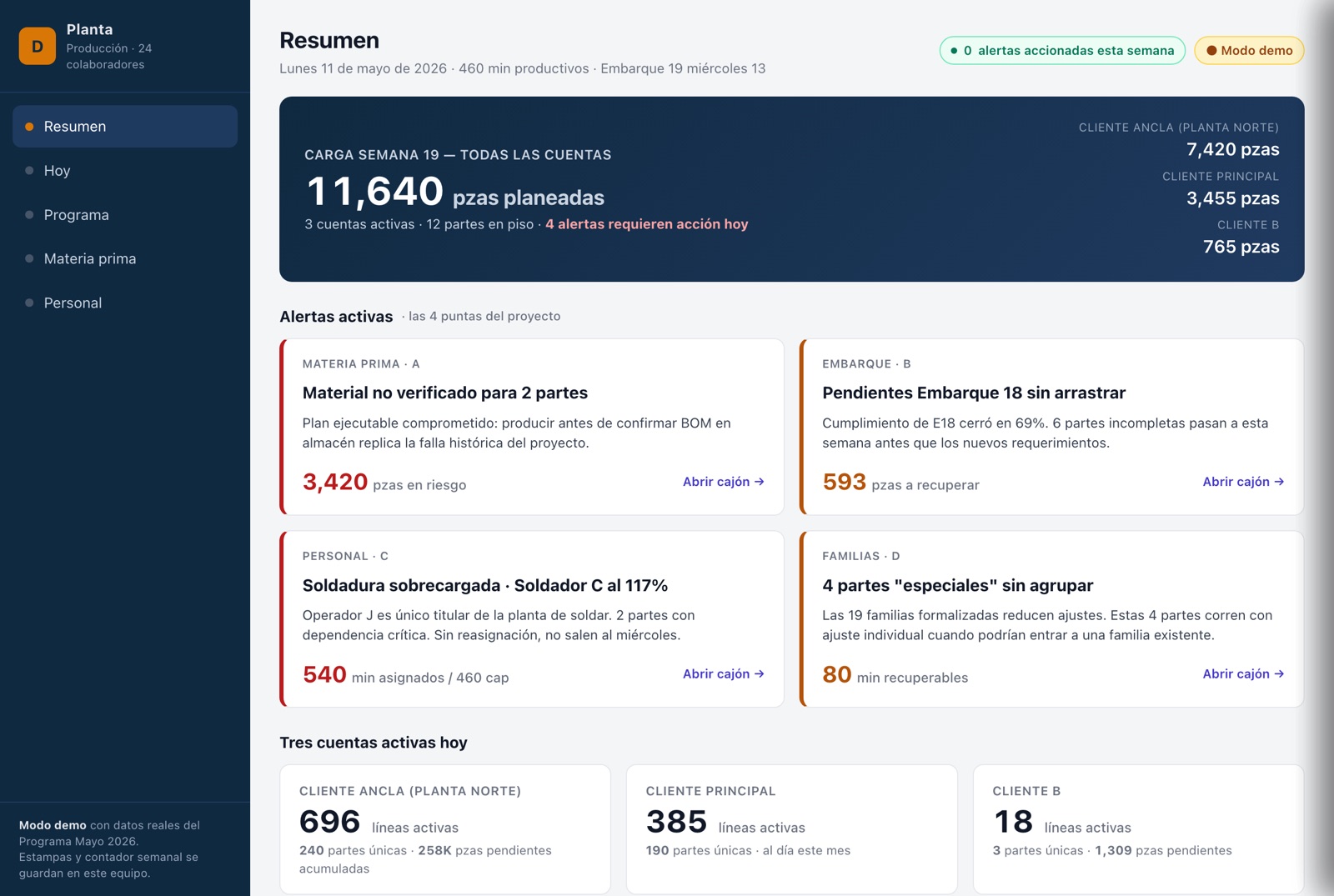
Capacity was running at about 21%. The machines weren't the problem — there was room to spare. The constraint was coordination: work waiting on other work, on decisions, on people being in the right place at the right time. Underneath that sat a single point of failure — one welder handled 84% of the catalog. And nearly 7,000 finished pieces were sitting in inventory that no order had ever asked for: capacity that had been spent building the wrong things.La capacidad corría a cerca del 21%. Las máquinas no eran el problema — había margen de sobra. La restricción era coordinación: trabajo esperando a otro trabajo, a decisiones, a que la persona correcta estuviera en el lugar correcto en el momento correcto. Debajo de eso había un punto único de falla — un solo soldador manejaba el 84% del catálogo. Y casi 7,000 piezas terminadas estaban paradas en inventario que ninguna orden había pedido: capacidad gastada en construir lo que no era.
- Capacity at ~21%Capacidad al ~21%: the machines had headroom. Adding more wouldn't have moved on-time shipping.las máquinas tenían margen. Agregar más no habría movido los embarques a tiempo.
- Coordination, not capacityCoordinación, no capacidad: the real constraint was how work got sequenced and handed off, not how much iron was on the floor.la restricción real era cómo se secuenciaba y se pasaba el trabajo, no cuánto fierro había en el piso.
- One welder, 84% of the catalogUn soldador, 84% del catálogo: a single point of failure that no amount of new equipment would fix.un punto único de falla que ningún equipo nuevo iba a resolver.
- ~7,000 pieces nobody ordered~7,000 piezas que nadie pidió: finished inventory built ahead of demand — capacity already spent on the wrong parts.inventario terminado hecho por delante de la demanda — capacidad ya gastada en las partes equivocadas.
What I builtQué construí
The diagnosis was worth nothing if it lived in a slide deck. So I built the decision system on top of the tools the team already trusts. It reads their spreadsheets without touching them — nothing migrated, nothing to relearn. It puts the week's plan next to what's actually shipping, so the gap is visible before Friday instead of after. And agents assemble the weekly plan and flag what needs attention now — the coordination work that used to live in someone's head and fall apart when that person was out.El diagnóstico no valía nada si se quedaba en una presentación. Así que construí el sistema de decisión encima de las herramientas en las que el equipo ya confía. Lee sus spreadsheets sin tocarlos — nada se migró, nada que reaprender. Pone el plan de la semana junto a lo que de verdad se está embarcando, para que el hueco se vea antes del viernes y no después. Y unos agentes arman el plan semanal y marcan lo que necesita atención ahora — el trabajo de coordinación que antes vivía en la cabeza de alguien y se caía cuando esa persona faltaba.
- Reads, doesn't replaceLee, no reemplaza: the system runs on their live spreadsheets. No migration, no new platform.el sistema corre sobre sus spreadsheets vivos. Sin migración, sin plataforma nueva.
- Plan vs. realityPlan contra realidad: the week's plan next to what's actually shipping, so drift shows up early.el plan de la semana junto a lo que de verdad se embarca, para que la desviación aparezca temprano.
- Agents that do the coordinationAgentes que hacen la coordinación: they assemble the weekly plan and surface what needs attention now.arman el plan semanal y sacan a la vista lo que necesita atención ahora.
Why it works this wayPor qué funciona así
The team already lives in Excel. A tool that asks them to abandon it is a tool they'll route around by week three. So the AI runs where the work already happens, on the files they already keep. That's the whole bet: the field research finds the real problem, the data modeling proves it, and the AI does the coordinating — without asking anyone to change how they work first.El equipo ya vive en Excel. Una herramienta que les pide abandonarlo es una herramienta que van a esquivar para la semana tres. Así que la IA corre donde el trabajo ya ocurre, sobre los archivos que ya llevan. Esa es toda la apuesta: el research de campo encuentra el problema real, el modelado de datos lo prueba, y la IA hace la coordinación — sin pedirle a nadie que cambie primero cómo trabaja.
Honest note: this is a live engagement. The on-time shipment target is what we're designing toward, not a result I'm claiming. Client anonymized.Nota honesta: este es un engagement en vivo. La meta de embarques a tiempo es hacia donde estamos diseñando, no un resultado que esté reclamando. Cliente anonimizado.