Nudge — winning back the user after the first ahaNudge — recuperar al usuario después del primer aha
A discovery case for a consumer personal-finance app that had lost seven points of 30-day retention. I framed the problem, triangulated the evidence, and made a bet on why the app stopped feeling relevant after week one — the full front end of a PM's job, before a single design exists.Un caso de discovery para una app de finanzas personales que había perdido siete puntos de retención a 30 días. Encuadré el problema, triangulé la evidencia y aposté por qué la app deja de sentirse relevante después de la semana 1 — el front end completo del trabajo de una PM, antes de que exista un solo diseño.
The problemEl problema
Nudge is a consumer personal-finance app: users connect their bank accounts, see where their money goes, set savings goals, and get nudges to stay on track. The acquisition funnel works — sign up, connect an account, see your spending. But 30-day retention had fallen from 44% to 37% over two quarters, and the drop wasn't in acquisition. It was after the initial "aha." A large share of users went passive: they opened the app less, stopped responding to nudges, and eventually churned. The home feed looked the same whether you'd been away a day or three weeks.Nudge es una app de finanzas personales de consumo: los usuarios conectan sus cuentas, ven a dónde se va su dinero, fijan metas de ahorro y reciben nudges para mantenerse en curso. El funnel de adquisición funciona — signup, conectar cuenta, ver tu gasto. Pero la retención a 30 días había caído de 44% a 37% en dos trimestres, y la caída no estaba en adquisición. Estaba después del "aha" inicial. Una porción grande de usuarios se volvía pasiva: abrían menos la app, dejaban de responder nudges y eventualmente churneaban. El home feed se veía igual lleves un día o tres semanas ausente.
My roleMi rol
PM of the Engage squad, the team that owns everything that keeps a user active after they connect their first account: home feed, weekly money summaries, savings nudges, and push notifications. I work in a triad with Raj (senior engineer) and Lena (product designer), and I report to Marcus (head of product). This was the front end of discovery — no designs, no committed scope, eight weeks from sprint kickoff. My job was to get the whole team aligned on the problem before anyone drew a screen.PM de la squad Engage, el equipo dueño de todo lo que mantiene al usuario activo después de conectar su primera cuenta: home feed, resúmenes semanales de dinero, savings nudges y push notifications. Trabajo en tríada con Raj (senior engineer) y Lena (product designer), y reporto a Marcus (head of product). Esto era el front end del discovery — sin diseños, sin scope comprometido, a ocho semanas del sprint kickoff. Mi trabajo era alinear a todo el equipo en el problema antes de que alguien dibujara una pantalla.
The hypothesisLa hipótesis
Users go passive because the app stops feeling relevant after week one. The initial spending breakdown is compelling, but after that Nudge doesn't give a reason to come back that feels personal, timely, and actionable. It gets genuinely valuable once it starts surfacing personal patterns — but power users told us that takes around three months, and most people leave before then. The "aha" lands, and then nothing continues the story.Los usuarios se vuelven pasivos porque la app deja de sentirse relevante después de la semana 1. El desglose de gasto inicial es atractivo, pero después Nudge no da una razón para volver que se sienta personal, oportuna y accionable. Se vuelve genuinamente valiosa cuando empieza a mostrar patrones personales — pero los power users nos dijeron que eso tarda unos tres meses, y la mayoría abandona antes. El "aha" aterriza, y luego nada continúa la historia.
Triangulating the evidenceTriangular la evidencia
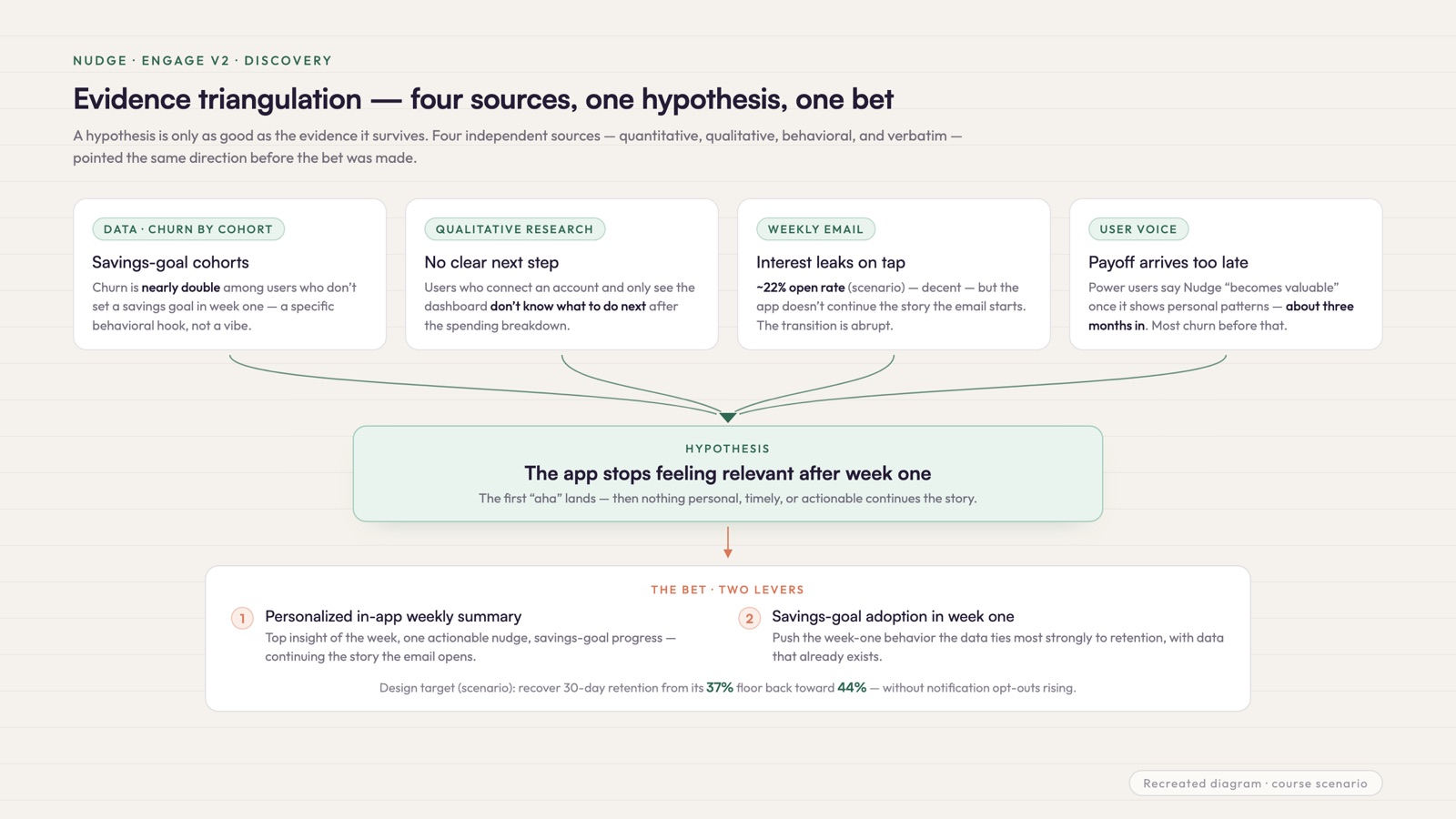
A hypothesis is only as good as the evidence it survives. I didn't want to lean on one source, so I lined up four that pointed the same direction from different angles:Una hipótesis vale lo que la evidencia que sobrevive. No quería apoyarme en una sola fuente, así que alineé cuatro que apuntaban en la misma dirección desde ángulos distintos:
- The data (Raj): the drop is sharpest among users who don't set a savings goal in week one — nearly double the churn versus those who do. That gave the hypothesis a specific behavioral hook, not just a vibe.El dato (Raj): la caída es más fuerte en usuarios que no fijan meta de ahorro en la semana 1 — casi el doble de churn vs. quienes sí lo hacen. Eso le dio a la hipótesis un gancho de comportamiento específico, no solo una intuición.
- The research (Lena): users who connect an account and only see the dashboard don't know what to do next. There's no clear "next step" after the spending breakdown.El research (Lena): quienes conectan la cuenta y solo ven el dashboard no saben qué hacer después. No hay un "siguiente paso" claro tras el desglose de gasto.
- The weekly email: a roughly 22% open rate — decent — but on tap the app doesn't continue the story the email started. The transition is abrupt, so the interest the email earns leaks away.El email semanal: un open rate de ~22% — decente — pero al hacer click la app no continúa la historia que empezó el email. La transición es abrupta, así que el interés que gana el email se fuga.
- The user voice: power users say Nudge "becomes valuable" once it shows personal patterns — but that takes about three months, and most people churn before the payoff.La voz de usuario: los power users dicen que Nudge "se vuelve valioso" cuando muestra patrones personales — pero eso tarda unos tres meses, y la mayoría churnea antes del payoff.
The betLa apuesta
Make the app feel personally relevant after week one, with two levers. First, a personalized in-app weekly summary — not the email: the week's top insight, one actionable nudge based on real patterns, and savings-goal progress. It continues the story the email opens instead of dropping the user into a generic home feed. Second, push savings-goal adoption in week one, since the data shows it correlates strongly with retention. Crucially, this is buildable with data that already exists; what's missing is the insight-ranking logic, not a new pipeline.Hacer que la app se sienta personalmente relevante después de la semana 1, con dos palancas. Primero, un resumen semanal personalizado in-app — no el email: el top insight de la semana, un nudge accionable basado en patrones reales y el progreso de la meta de ahorro. Continúa la historia que abre el email en vez de soltar al usuario en un home feed genérico. Segundo, empujar la adopción de meta de ahorro en la semana 1, ya que el dato muestra que correlaciona fuerte con retención. Clave: esto es construible con datos que ya existen; lo que falta es la lógica de ranking de insights, no un pipeline nuevo.
The tension I had to holdLa tensión que tuve que sostener
Engagement volume versus notification fatigue. The easy version of this bet is "send more nudges," and it's the wrong version — more nudges saturate people and push them toward opting out, which makes retention worse, not better. The whole point is better nudges: relevant and timely, not louder. So the bet had to be judged on whether engagement went up without notification opt-outs going up alongside it. If it couldn't clear that bar, it wasn't a win.Volumen de engagement vs. fatiga de notificaciones. La versión fácil de esta apuesta es "manda más nudges", y es la versión equivocada — más nudges saturan a la gente y la empujan a opt-out, lo que empeora la retención, no la mejora. Todo el punto son mejores nudges: relevantes y oportunos, no más ruidosos. Así que la apuesta tenía que juzgarse por si el engagement subía sin que subieran los opt-outs de notificaciones junto con él. Si no libraba esa barra, no era una ganancia.
Targets I designed forMetas para las que diseñé
Because this is a course scenario in discovery, these are the signals I defined as success, not results I measured. I designed to recover 30-day retention back toward 44% from its 37% floor — the seven points that started the whole investigation. I set a higher week-one savings-goal set rate as a leading indicator, since the data tied that behavior to retention. And I made engagement with the in-app weekly summary conditional on notification opt-outs holding flat, so a shallow engagement bump couldn't disguise notification fatigue. These are the thresholds the bet was built to meet, against a scenario backdrop of a four-year-old, Series B ($42M) app with 2.1M registered users and MAU growing 28% year over year.Como esto es un escenario de curso en fase de discovery, estas son las señales que definí como éxito, no resultados que haya medido. Diseñé para recuperar la retención a 30 días hacia 44% desde su piso de 37% — los siete puntos que arrancaron toda la investigación. Fijé una mayor tasa de fijación de meta de ahorro en la semana 1 como indicador adelantado, dado que el dato ató ese comportamiento a la retención. Y condicioné el engagement con el resumen semanal in-app a que los opt-outs de notificaciones se mantuvieran planos, para que un bump superficial de engagement no disfrazara fatiga de notificaciones. Estos son los umbrales que la apuesta fue construida para alcanzar, contra un telón de fondo de escenario: una app de cuatro años, Serie B ($42M), con 2.1M de usuarios registrados y MAU creciendo 28% año contra año.
The sharpest callLa decisión más afilada
The move I'm proudest of was refusing to let engagement stand in as its own success metric. It's the tempting number — it goes up, the demo looks great, everyone claps. But engagement that comes from more notifications while opt-outs quietly climb is a retention loss wearing a retention costume. Tying the win to opt-outs holding flat is what turned "ship more nudges" into "ship better nudges," and it's the decision that kept the whole bet honest before a single pixel got drawn.La jugada de la que estoy más orgullosa fue negarme a dejar que el engagement funcionara como su propia métrica de éxito. Es el número tentador — sube, el demo se ve increíble, todos aplauden. Pero engagement que viene de más notificaciones mientras los opt-outs trepan en silencio es una pérdida de retención disfrazada de retención. Atar la ganancia a que los opt-outs se mantengan planos es lo que convirtió "manda más nudges" en "manda mejores nudges", y es la decisión que mantuvo honesta toda la apuesta antes de dibujar un solo pixel.
This is a Claude Code for PMs course exercise, not a shipped product. Nudge, the Engage squad, and every number here (37% and 44% retention, 28% YoY MAU, $42M, 2.1M users, ~22% open rate) come from the course scenario — they're context and design targets, not outcomes I produced. The work sits in the discovery phase: nothing was designed, built, or shipped to users.Este es un ejercicio del curso Claude Code for PMs, no un producto lanzado. Nudge, la squad Engage y cada número aquí (37% y 44% de retención, 28% YoY en MAU, $42M, 2.1M usuarios, ~22% de open rate) vienen del escenario del curso — son contexto y metas de diseño, no resultados que yo haya producido. El trabajo está en la fase de discovery: nada se diseñó, construyó ni lanzó a usuarios.